India Data Center Hub: The Powerful Rise of a Global Tech Giant

The India Data Center Hub story is no longer a quiet trend happening in the background. It has become one of the biggest infrastructure shifts of the decade. Over the past few months, the world’s largest technology companies have made it clear that India is now central to their global plans. Microsoft, Amazon, and Google have collectively pledged tens of billions of dollars toward building artificial intelligence and cloud infrastructure across the country.
This is not just about a few new buildings filled with servers. The rise of the India Data Center Hub reflects a deeper change in how the digital world is being built, where data is stored, and who controls the future of AI. In this blog, we will break down exactly why India is becoming a global data center hub, who is investing, what is driving the boom, and what it means for businesses, investors, and everyday users.
The Big Tech Investment Wave Fueling the India Data Center Hub
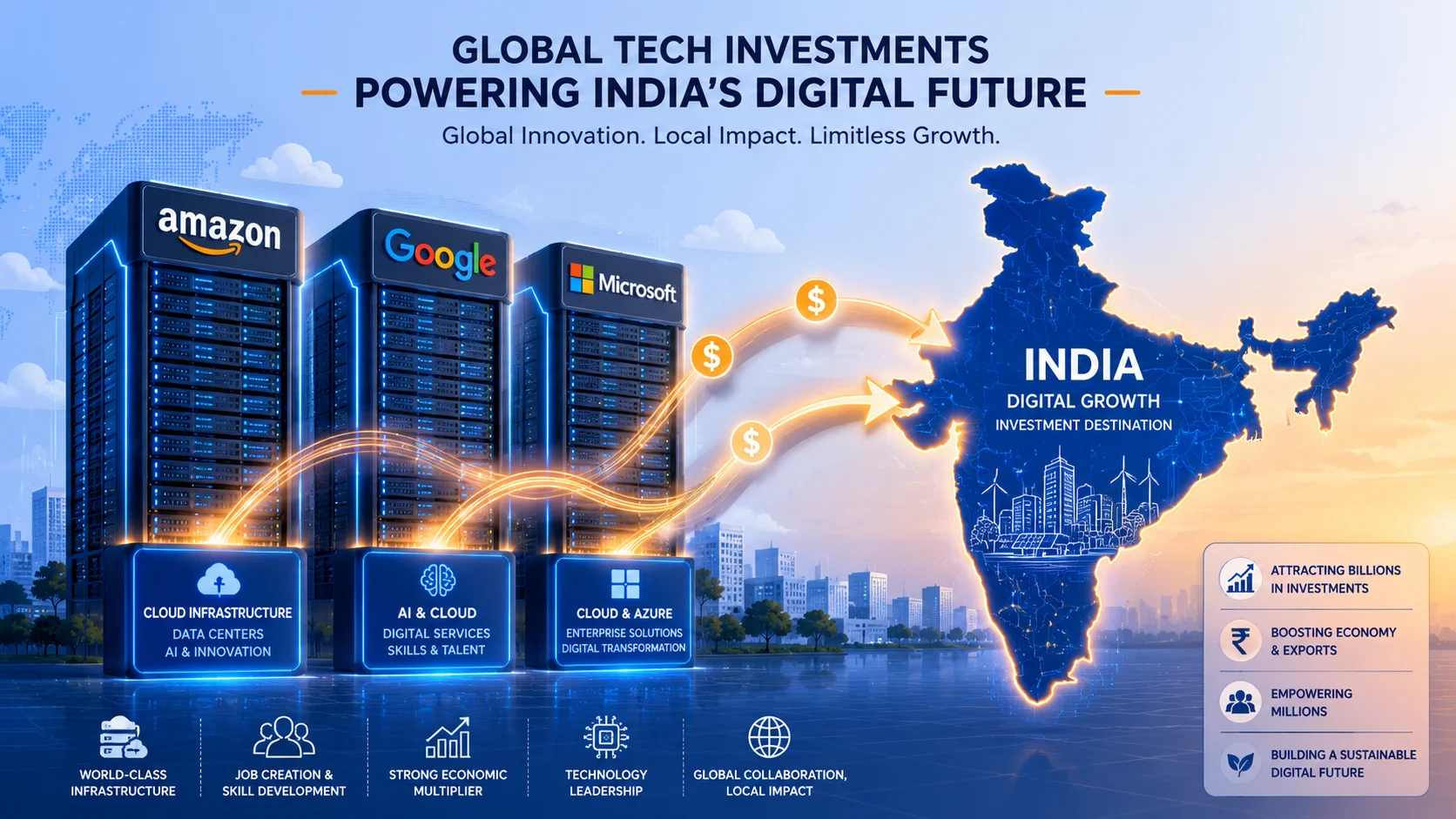
The clearest signal that India has arrived as a serious data center hub is where the money is going. The numbers are staggering.
Microsoft confirmed an investment of around 17.5 billion US dollars in India, its largest commitment anywhere in Asia. This four-year plan, starting in 2026, is designed to expand hyperscale infrastructure, embed AI into national platforms, and build a future-ready workforce. Microsoft’s goal is to become the country’s largest cloud-computing provider.
Amazon went even further. In mid-2026, Amazon announced plans to raise its total India investment commitment to roughly 48 billion US dollars by 2030, building on its earlier 35 billion dollar pledge. A large part of this is aimed at scaling AI and cloud infrastructure while creating around a million jobs.
Google, meanwhile, announced a 15 billion US dollar AI infrastructure plan for India spread over 2026 to 2030. In partnership with AdaniConneX, Google is building what is set to become India’s largest AI data center campus in Visakhapatnam, Andhra Pradesh, supported by subsea cable networks and clean energy.
Together, these three companies have pledged a combined amount in the tens of billions toward Indian digital infrastructure in just a few months. And they are not alone. Australia’s AirTrunk has announced plans to invest around 30 billion dollars to build 5 gigawatts of capacity by 2030, while global investors and pension funds are pouring money into the sector as well.
When this much capital flows in this quickly, it confirms one thing clearly. The India Data Center Hub is being treated as a long-term strategic asset, not a short-term experiment.
Key Drivers Behind the India Data Center Hub Growth
So what is actually driving this boom? Several powerful forces are working together at the same time.
1. The AI and Cloud Explosion
Artificial intelligence is the single biggest driver. Training and running large AI models requires enormous amounts of GPU-powered computing. Every chatbot query, every AI image, and every machine-learning model needs a physical home, and that home is a data center. As AI adoption explodes across India and globally, demand for high-density, AI-ready facilities has skyrocketed.
2. A Massive Digital Population
India is one of the largest internet markets on Earth, with hundreds of millions of users streaming video, shopping online, and making digital payments every single day. All of this activity generates a vast amount of data that needs to be stored and processed close to where it is created. This local demand alone justifies a thriving data center hub.
3. Cost and Power Advantages
Compared to mature markets, India offers more affordable land and construction. Crucially, renewable-linked power purchase agreements can cut operating costs significantly versus standard grid tariffs. Since electricity is one of the largest ongoing expenses for any data center, this power advantage is a major reason global operators are choosing India.
4. Strategic Location and Connectivity
India’s coastline is becoming a global connectivity gateway. New subsea cable systems landing in Chennai and Mumbai are dramatically reducing latency between India, Europe, and Singapore. This makes the India Data Center Hub attractive not just for serving Indian users, but for handling real-time workloads from across Asia and beyond.
5. A Deep Talent Pool
India produces a huge number of engineers, developers, and IT professionals every year. This skilled workforce makes it easier and cheaper to build, operate, and maintain large-scale digital infrastructure, giving the country a clear edge over many competing markets.
India Data Center Hub: Capacity, Market Size, and Hotspots
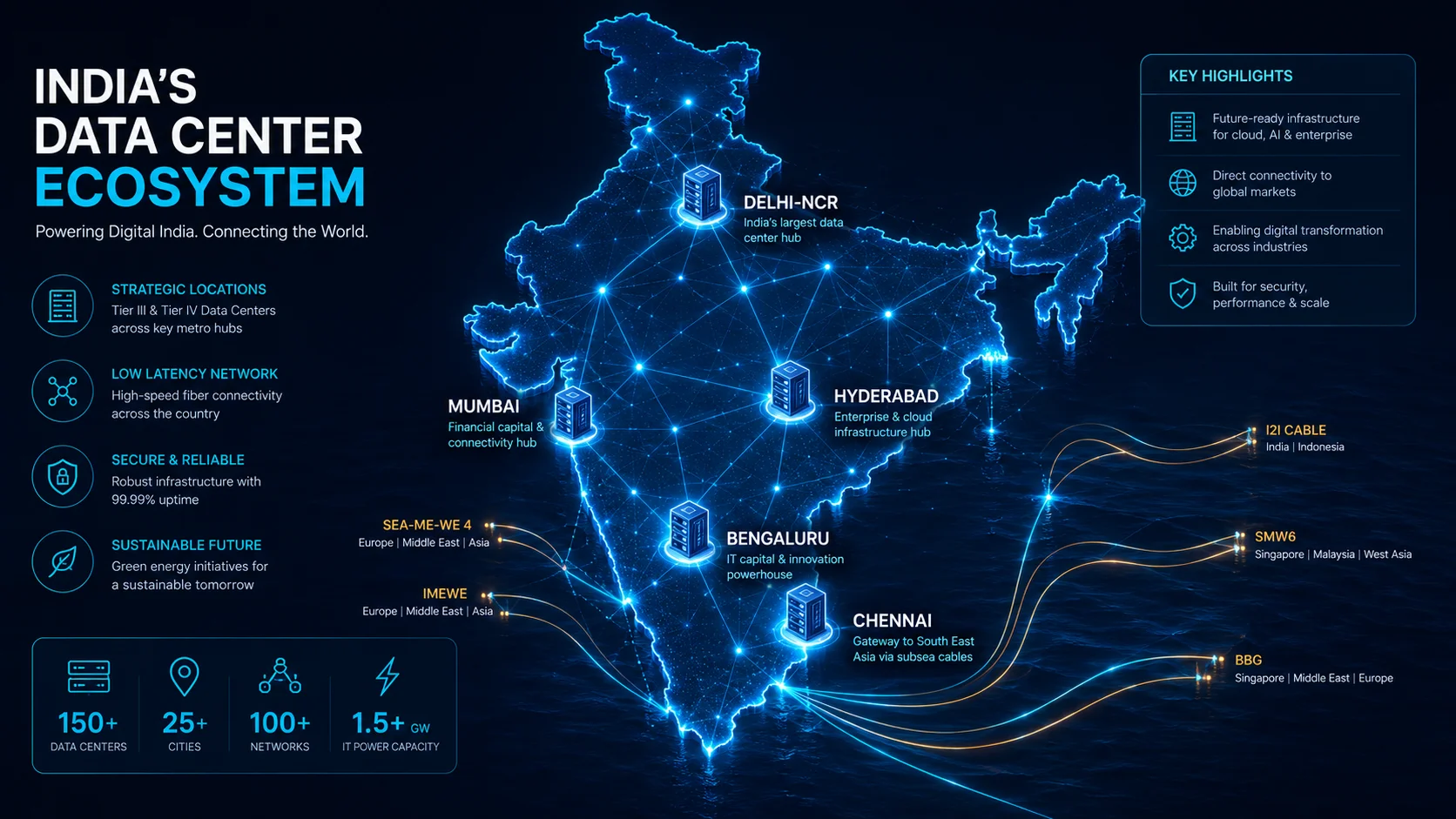
To understand the scale of this growth, it helps to look at the numbers and the geography.
The Indian data center market was valued at roughly 10 billion US dollars in 2025 and is projected to grow toward 27 billion dollars by 2032. In terms of raw capacity, some forecasts expect installed power to climb from around 5.45 gigawatts in 2026 to more than 15 gigawatts by 2031, growing at well over 20 percent per year.
Geographically, the India Data Center Hub is concentrated in a few key cities:
- Mumbai and Navi Mumbai lead the country with around 790 megawatts, accounting for more than half of total capacity. The region benefits from submarine cable landing stations, large land parcels, and its status as India’s financial capital.
- Chennai follows with roughly 305 megawatts, anchored by multiple subsea cables that make it ideal for latency-sensitive traffic.
- Bengaluru, the country’s tech capital, holds around 182 megawatts and continues to expand rapidly.
- Hyderabad has emerged as a strong AI infrastructure destination with about 152 megawatts and several gigawatt-scale projects in the pipeline.
- Delhi-NCR, Noida, Pune, and Kolkata round out the major markets, while edge data centers are now spreading into Tier-2 cities like Bhubaneswar, Lucknow, and Guwahati.
This spread shows that the India Data Center Hub is no longer limited to one or two cities. It is becoming a nationwide ecosystem.
Government Policies Powering the India Data Center Hub
Private investment is only half the story. The Indian government has actively created an environment designed to attract global capital.
A standout move came in the Union Budget 2026 to 2027, which introduced a 20-year tax exemption valid until 2047 for foreign companies offering cloud services to global clients through data centers located in India. This is a huge long-term incentive for international operators.
On top of that, several policies are accelerating growth:
- Infrastructure status for data centers, which unlocks low-cost financing and policy stability.
- The Digital Personal Data Protection Act, which strengthens data localization and keeps Indian data within national borders.
- RBI data localization mandates that require payment-system data to be stored domestically, creating guaranteed demand from the banking and finance sectors.
- State-level data center policies in Maharashtra, Karnataka, Telangana, Tamil Nadu, Uttar Pradesh, Rajasthan, and more, offering land subsidies of 25 to 50 percent, stamp duty exemptions, and fast-track approvals.
- The IndiaAI Mission and a draft National Data Centre Policy that further tie incentives to capacity growth, energy efficiency, and job creation.
This combination of national and state-level support is exactly why so many companies feel confident building a data center hub in India for the long run.
Advantages of India Becoming a Global Data Center Hub
The rise of the India Data Center Hub brings real benefits that go far beyond the technology sector.
- Job creation: Building and running these facilities creates jobs in construction, engineering, security, operations, and renewable energy.
- Faster digital services: More local capacity means lower latency, so apps, streaming, and online services run faster and more reliably for Indian users.
- Stronger data sovereignty: Storing data within the country improves privacy, security, and regulatory compliance, especially for banks and government services.
- Economic growth: Billions in foreign investment boost the economy, strengthen the rupee’s investment story, and develop supporting industries like power and real estate.
- Innovation boost: Easy access to powerful, affordable computing helps Indian startups and enterprises build AI products at a global scale.
- Global positioning: A strong data center hub firmly establishes India as a critical node in the world’s digital supply chain.
Disadvantages and Challenges to Watch
No boom comes without challenges, and an honest look at the India Data Center Hub must include the risks.
- High energy consumption: Data centers are extremely power-hungry. Without enough renewable energy, rapid expansion can strain local grids and increase carbon emissions.
- Water usage: Many cooling systems rely heavily on water, which can be a concern in regions already facing water stress.
- Grid and infrastructure pressure: A single large facility can consume as much power as a small town, putting pressure on local utilities.
- Land and cost competition: In hotspots like Mumbai and Bengaluru, land costs are high and competition for prime locations is intense.
- Regulatory uncertainty: While policies are improving, differing legal interpretations around cross-border data transfers can create uncertainty for multinationals.
- Sustainability balance: The industry must grow responsibly, or environmental concerns could slow it down.
Recognizing these challenges is important. The most successful players in the India Data Center Hub will be those that invest in green power, efficient cooling, and sustainable design from the start.
Tips and Tricks: How to Benefit From the India Data Center Hub Boom
Whether you are a business owner, investor, student, or professional, here are practical ways to ride this wave.
- For investors: Look beyond the big tech names. Watch data center REITs, renewable energy companies, cooling technology firms, and real estate players in Mumbai, Chennai, and Hyderabad that support this ecosystem.
- For businesses: Take advantage of cheaper, faster local cloud capacity. Migrating to India-based cloud regions can reduce latency and help you stay compliant with data localization rules.
- For students and job seekers: Build skills in cloud computing, data center operations, networking, AI infrastructure, and sustainable energy. These are exactly the roles being created right now.
- For startups: Use the falling cost of compute to build AI-driven products. Affordable GPU access is one of the biggest gifts of the India Data Center Hub.
- For professionals: Certifications in AWS, Azure, and Google Cloud are increasingly valuable as hyperscale operators expand their Indian footprint.
The key trick is simple. Position yourself early, because the gap between those who adapt to this shift and those who ignore it will only grow wider.
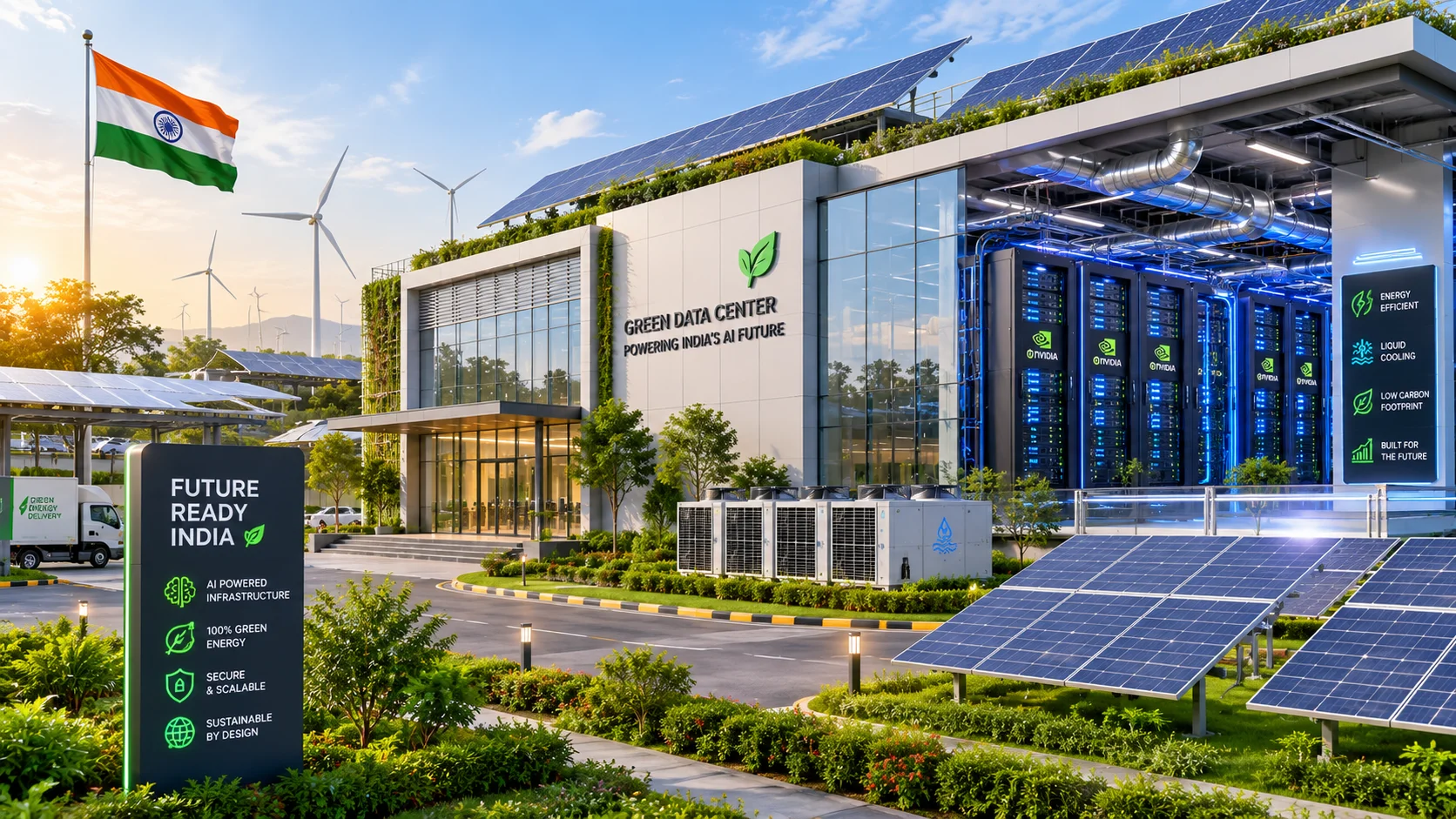
The Road Ahead for the India Data Center Hub
Looking forward, every signal points in the same direction. Capacity is expected to multiply several times over by 2030. New subsea cables are landing on Indian shores. Government incentives are locked in for two decades. And the biggest names in technology have publicly committed their futures to this market.
The next phase will likely be defined by AI-first facilities packed with GPUs, green data centers powered by solar and wind, and the spread of edge computing into smaller cities. India is not just hosting data anymore. It is becoming a place where the world’s intelligence is trained, stored, and served.
Conclusion
The transformation of India into a global data center hub is one of the most important technology stories of our time. With Microsoft, Amazon, and Google pledging tens of billions of dollars, supportive government policies, world-class talent, and unbeatable cost advantages, India has all the ingredients to lead the next era of digital infrastructure.
There are real challenges around energy, water, and sustainability that must be managed carefully. But the momentum is undeniable. The India Data Center Hub is here, it is growing fast, and it is reshaping the future of AI and cloud computing for the entire world.
If you found this breakdown helpful, explore more technology insights and free AI tools on our site, and stay ahead of the trends that are shaping tomorrow’s digital economy.